
The AI opportunity next door: become the person who makes a local workflow work
You may already know the hardest part of an AI project: how the business actually works. Here is how to turn that knowledge into a useful local project, a stronger work sample, or a conversation about your next role.
Look for the handoff everyone keeps fixing
A business owner does not wake up wanting a prompt engineer. They want a new inquiry answered, a proposal ready, or a team member trained without explaining the same process again. AI creates an opportunity wherever those ordinary jobs need a better connection between information, tools, and people.
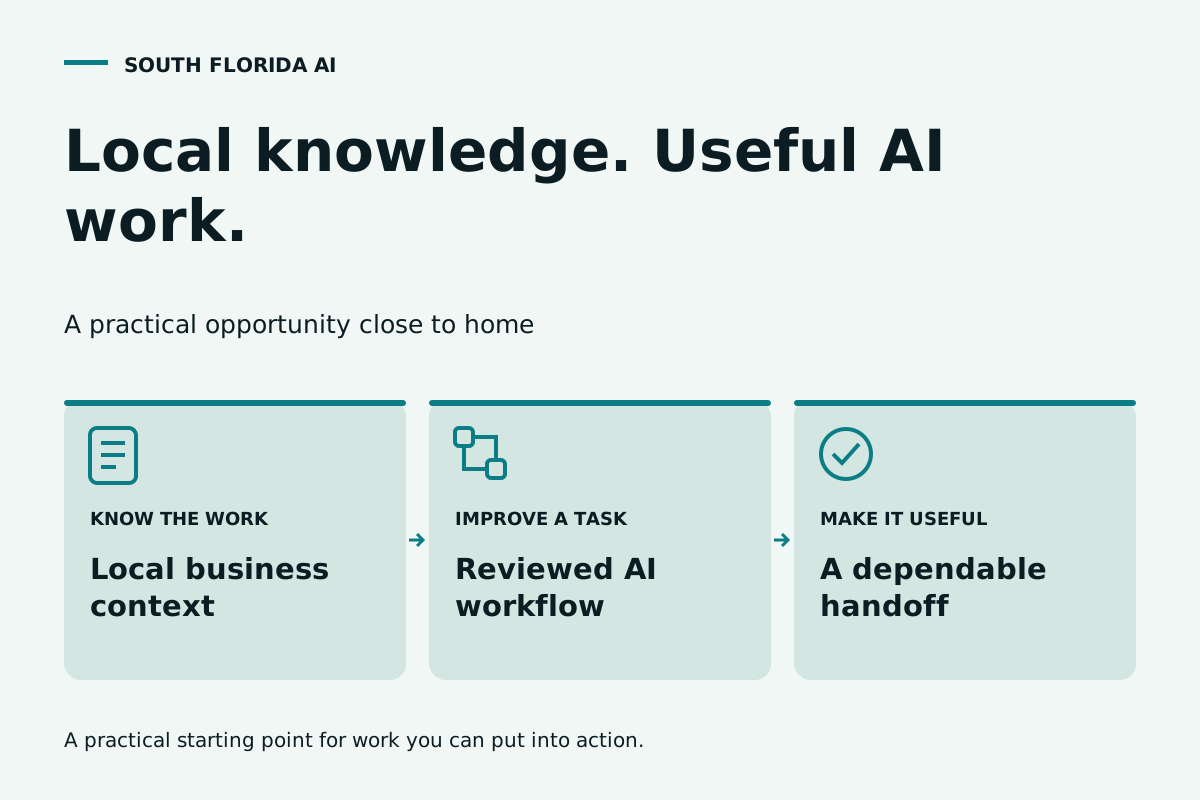
Our take for South Florida: the useful starting point is a workflow you understand well enough to improve. A hospitality coordinator knows which guest requests need a manager. An office administrator knows what makes a service inquiry incomplete. A marketer knows which claims need the owner's approval. That practical knowledge gives an AI project its boundaries and its purpose.
Indeed’s 2024 article prompted this practical look at changing work.
Three projects worth discussing with a local business
For a home-service company in Palm Beach County, try an inquiry handoff: summarize a customer's request, flag the missing details, and prepare a reply for the coordinator. Keep scheduling commitments and prices tied to the company's approved information.
For a hospitality team in Fort Lauderdale, try a staff knowledge guide: organize approved answers to recurring guest questions and show the employee where each answer came from. Give changing policies an owner and a review date.
For a Miami professional-services team, try a meeting-to-next-step workflow: separate decisions, open questions, and assigned actions, then prepare a follow-up draft. These are project ideas to investigate with businesses you know. The first conversation should establish whether the problem occurs often enough to matter.
Your four-step starting plan
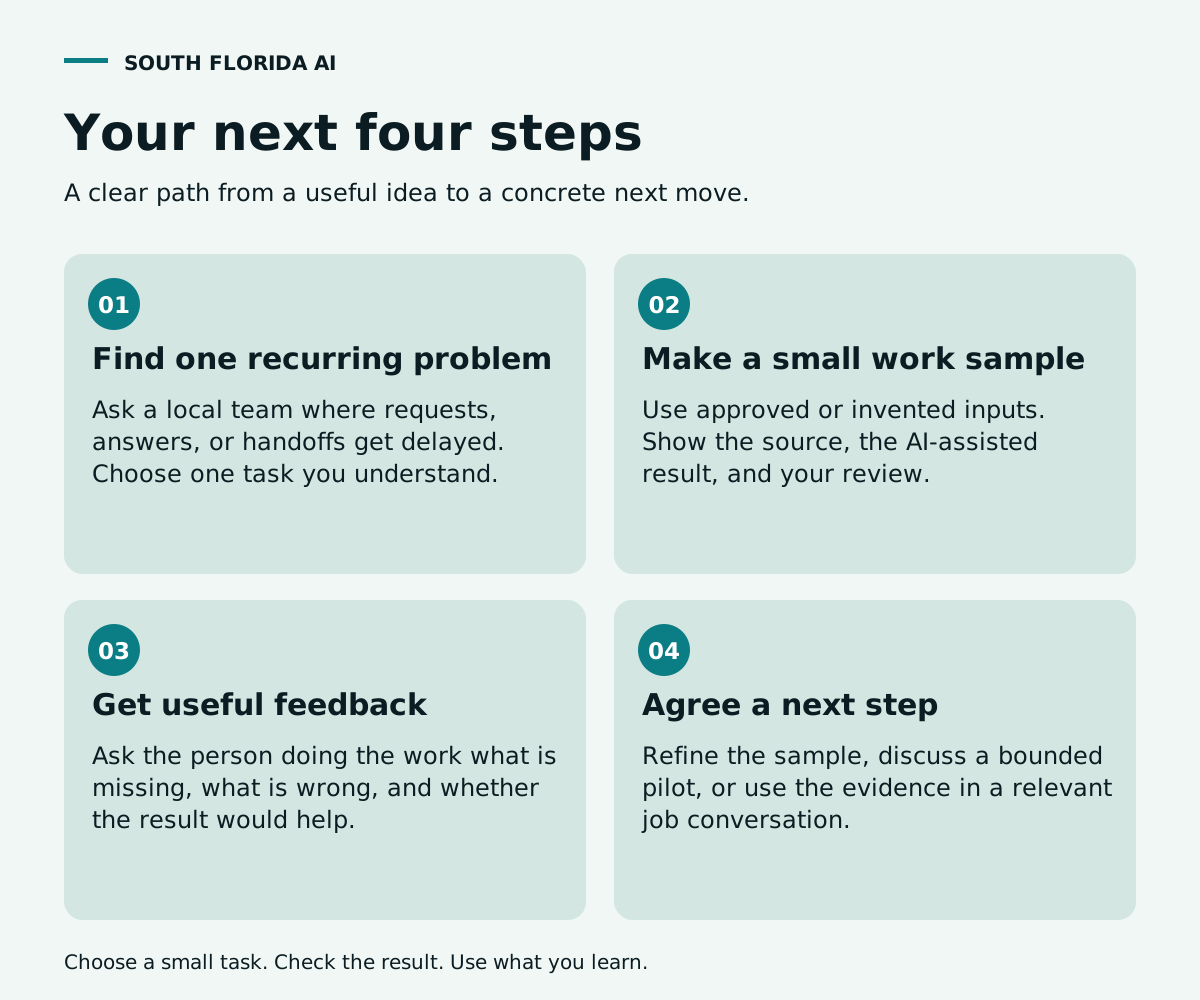
Find one recurring problem
Ask a local team where requests, answers, or handoffs get delayed. Choose one task you understand.
Make a small work sample
Use approved or invented inputs. Show the source, the AI-assisted result, and your review.
Get useful feedback
Ask the person doing the work what is missing, what is wrong, and whether the result would help.
Agree a next step
Refine the sample, discuss a bounded pilot, or use the evidence in a relevant job conversation.
Build a small example people can understand
Imagine you are helping a Palm Beach Gardens landscape company investigate its inquiry process. Your practice input is a short message: 'We need help with our backyard. Are you available next week?' A useful output does not invent the property size, promise an appointment, or guess the budget. It captures the request and drafts three questions that help the coordinator decide what happens next.
Show the original message beside the proposed handoff. Explain which information the AI organized, which questions you chose, and which decisions belong to the coordinator. Add a second message with an urgent safety concern and show how that gets sent to a person. The interesting part of the sample is your judgment about the exception.
A clear one-page example is enough for an initial conversation. Bring the problem, the proposed improvement, and the question you need answered. You do not need a large application to learn whether a business would use the result.
Use local connections to learn what is needed
Start with a business, employer, or community organization whose work you already understand. Ask where requests get delayed, what people repeatedly correct, and who would use an improved handoff. Ask to see a redacted example instead of collecting private customer records.
At a meetup, introduce the task you are exploring: 'I'm learning how to make service inquiries easier for the office team to review.' That invites a useful conversation. A vague introduction about doing AI makes it harder for someone to connect your work to a real need.
If you are job hunting, look for the same responsibilities inside operations, customer experience, training, and marketing roles. A company may need this work without using a new AI title. Read the duties and expected deliverables before deciding whether a role fits.
Make your first month count
Choose one field, one recurring task, and one person who can judge the result. Learn enough about the tool to complete that task, then spend time improving the input and review process. The World Economic Forum's 2025 employer survey emphasizes technological literacy alongside analytical and creative thinking; those abilities work together in a practical project.
Keep a short record of the original process, the change, and what happened in each trial. Include preparation and checking time when comparing methods. Finish with a sample you can explain and a specific next question for a local business. That gives you something concrete to bring to your next introduction.
Put this guide to work.
Choose one idea to try today. Use the next resource to turn it into a practical skill or a new connection.
Request a topic or workshopKeep exploring
AI trends to watch: connected work, reusable skills, and better review
Three sourced developments and practical experiments for local professionals. Our interpretation is separate from announced product plans.
Read the guide →AI in South Florida: What's Being Built Here in 2026
From a planned ServiceNow AI hub in West Palm Beach to new AI degrees at local colleges, South Florida is quietly building real AI capacity. Here's what's happening — with sources.
Read the guide →Data Centers in South Florida: What's Here, What's Proposed, and the New Rules
AI runs on data centers, and South Florida is now part of that conversation — from Miami's internet gateway to Latin America to proposed hyperscale campuses and a new state law. A sourced overview.
Read the guide →