
A practical Claude workflow for South Florida small-business teams
Turn a weekly enquiry review into a shared tracker and a clearer follow-up plan.

Start with one useful decision
A small team in West Palm Beach, Boca Raton or Miami can lose useful enquiries between a form, an inbox and a weekly meeting. Before buying another system, map who responds and how the team knows the enquiry was handled. Claude Sheets and Whiteboards can help make that conversation visible. This example uses invented counts for a local service business.
What Anthropic announced
On November 10, 2026, Anthropic introduced Claude Sheets and Whiteboards in beta and made Claude Data, formerly Dashboards, generally available on paid plans. Sheets supports editable formulas and Excel/CSV export; Whiteboards supports shared visual planning. Data works with connected data sources and adds visual stories, including narrated videos. Certified queries and live sharing remain beta features.
Interactive connectors are also expanding to full app views where supported, including Adobe and Atlassian. Availability depends on rollout and organizational settings. Claude Meetings is described as coming soon in the overview; the Whiteboards help page documents Google Meet beta support on Team and Enterprise. Check your account before planning around it; Zoom and Microsoft Teams are not supported in that documented beta.
Before you start
Open Claude and confirm that your paid account has the Sheets and Whiteboards templates in Artifacts. Team plans enable them by default; an Enterprise owner must enable them. If a template is missing, check your plan and organization settings before following this exercise. No live meeting or connected business account is required for the sample below.
Start a chat, paste the labeled sample data and ask for a Sheet. In a separate request, ask for a Whiteboard using the reviewed findings. Copy the relevant context explicitly: the Whiteboards help page says connected-app context is not currently available to the board. These are suggested prompts, not a transcript of a hands-on test in Claude.
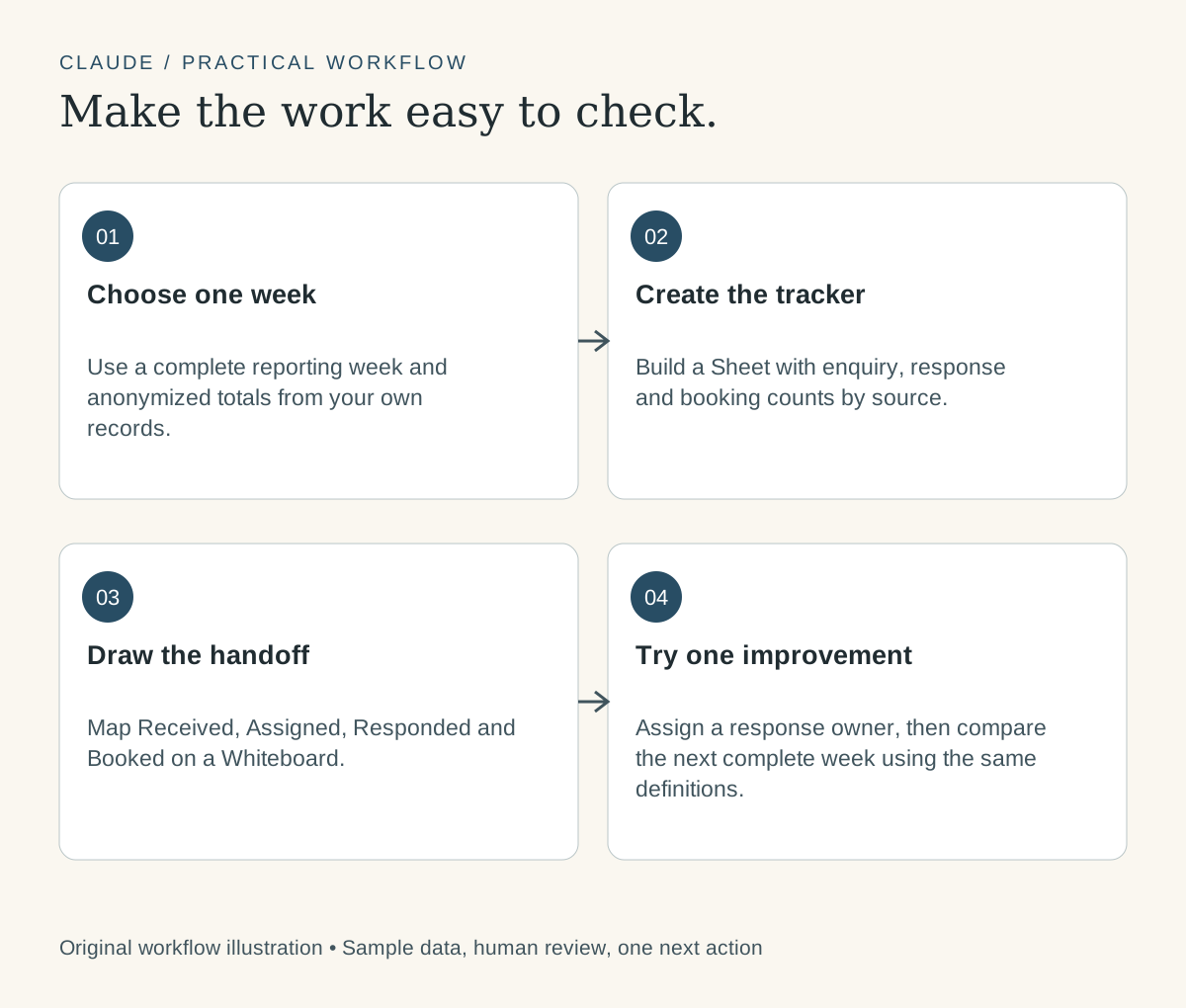
Your four-step workflow
Choose one week. Use a complete reporting week and anonymized totals from your own records.
Create the tracker. Build a Sheet with enquiry, response and booking counts by source.
Draw the handoff. Map Received, Assigned, Responded and Booked on a Whiteboard.
Try one improvement. Assign a response owner, then compare the next complete week using the same definitions.
Worked example: Where should the owner inspect the enquiry-to-booking process?
Fictional practice example. These inputs and expected outputs demonstrate the method. They are not client results, portfolio metrics or evidence that this task was run in Claude.
Website forms: 3 without a recorded response and 33.3% booked. Phone: 0 and 58.3%. Social messages: 4 and 20%. Seven of 40 enquiries lack a recorded response.
A missing response record is not proof that nobody replied. Check the underlying records before describing a lead as lost. Start with the social-message handoff because four of ten enquiries lack a recorded response. Agree on an owner and a way to mark completion without putting customer details on a public board.
| Decision field | Your note |
|---|---|
| Website form | 18 · 15 · 6 |
| Phone | 12 · 12 · 7 |
| Social message | 10 · 6 · 2 |
Copy the spreadsheet prompt
Create a Claude Sheet using only the following SYNTHETIC PRACTICE DATA. Do not connect accounts or invent missing values. Keep raw inputs separate from calculations. Include visible formulas and an Assumptions tab. The decision is: Where should the owner inspect the enquiry-to-booking process?

Source,Enquiries,Responded,Booked
Website form,18,15,6
Phone,12,12,7
Social message,10,6,2

Use these formulas, with the header in row 1:
E2 = B2-C2  → enquiries without a recorded response
F2 = IF(B2=0,"",D2/B2)  → booking rate; format as %

Explain the calculation and flag missing inputs. Keep zero denominators blank and identify why the result is unavailable. Do not claim these are real business results.
Copy the whiteboard prompt
Create a Whiteboard for this reviewed sample. Make four sections: Evidence, Assumptions, Open questions, and Next action. Evidence: Website forms: 3 without a recorded response and 33.3% booked. Phone: 0 and 58.3%. Social messages: 4 and 20%. Seven of 40 enquiries lack a recorded response. Interpretation to review: A missing response record is not proof that nobody replied. Check the underlying records before describing a lead as lost. Start with the social-message handoff because four of ten enquiries lack a recorded response. Agree on an owner and a way to mark completion without putting customer details on a public board. Add one owner and review-date placeholder; do not invent names or commitments. Keep the sample labeled fictional. Do not send messages or change connected apps.Make the handoff useful
A useful first team exercise can fit into a short working session: one person explains the current process, another checks the sample totals, and the owner chooses a single handoff to improve. This article is a practice exercise, not an announcement of a scheduled local event. Use the community calendar for actual dates.
Before sharing, check one ordinary row, one missing value and one zero-denominator case. Confirm that totals use the intended rows. Open the exported Excel file and inspect formulas and formatting; a CSV export does not preserve a workbook’s tabs and presentation. Share only the reviewed version with the intended people.
If you later use Claude Data, inspect the data source, metric definition and refresh time. Ask for the uncertainty to appear in any data story. If Meetings is available to your team, follow your organization’s participant-notice and recording practices; otherwise use notes you are permitted to share. The worksheet exercise works without a meeting assistant.
Try it on one real task
Replace the sample with data you are authorized to use, keep the same review question and record what needed correction. A useful first result is a checked artifact and a decision someone can act on.
Find practical AI learning in South Florida →
Official sources
Feature information checked November 11, 2026. Examples, prompts and interpretation are original editorial guidance.
Anthropic: Sheets, Whiteboards and Data — November 10, 2026
Claude Help: getting started with Sheets
Claude Help: Whiteboards, including Meetings availability and limitations
Anthropic: interactive connectors and full apps
Anthropic: the wider workplace announcement
Put this guide to work.
Choose one idea to try today. Use the next resource to turn it into a practical skill or a new connection.
Find practical AI learning in South FloridaKeep exploring
Can an AI assistant understand your South Florida business?
A practical local-business guide to clear service areas, event details, booking handoffs and llms.txt—with a Palm Beach County example.
Read the guide →A ChatGPT agent for your South Florida business: start with the questions customers ask
A practical preparation plan for South Florida businesses: clarify your offer, collect customer questions, and test the handoff to your website.
Read the guide →Agent harnesses and inference: how AI gets useful work done
Understand the model, the harness, and the checks around an AI workflow. Then test one small business task with a clear result and a human review point.
Read the guide →